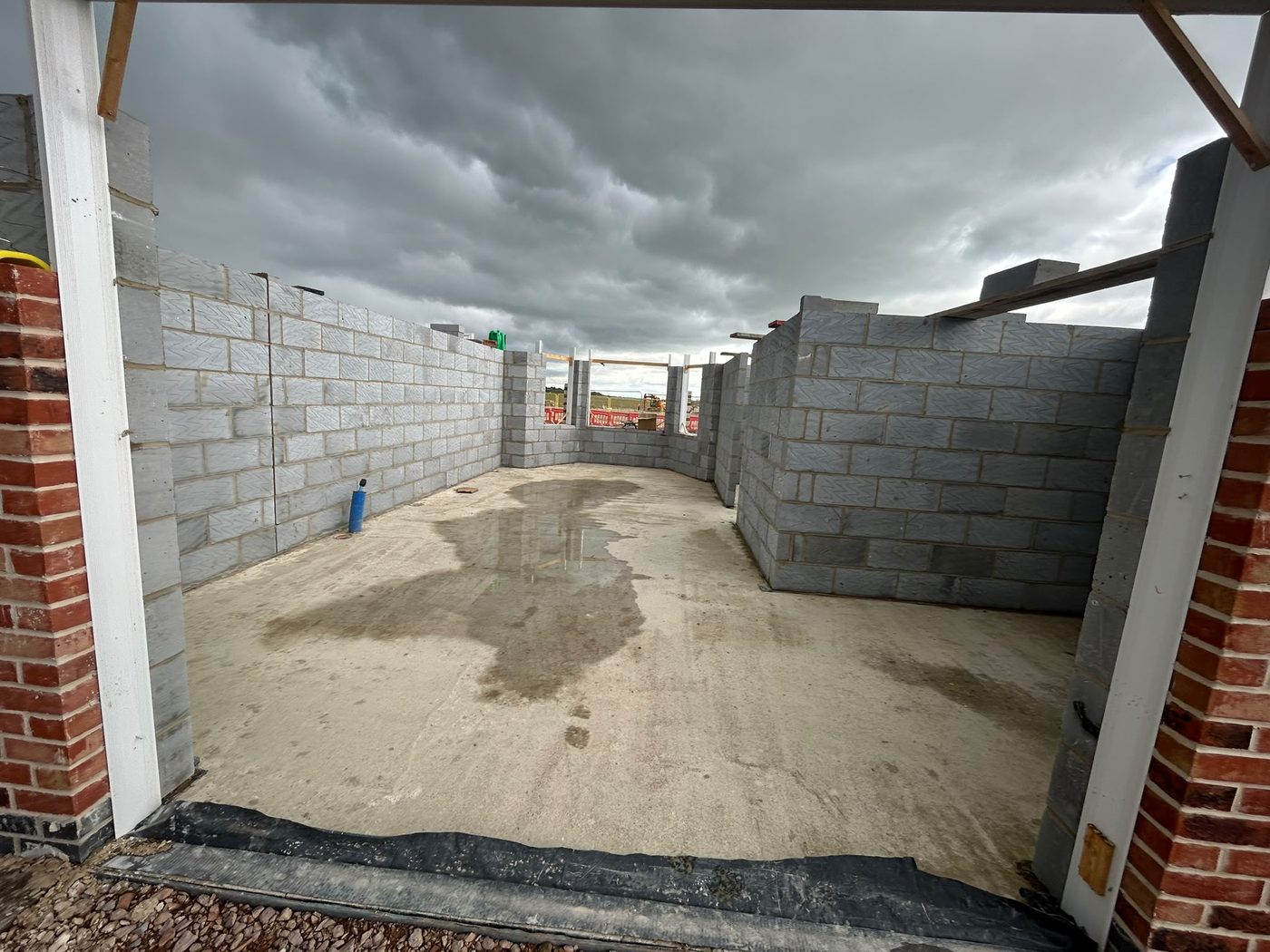
The inner leaf, the party walls and the internal partitions decide whether everything after us fits. Blockwork that is level, plumb and square means the joiner is not packing out door linings and the plasterer is not burying twenty millimetres of dab in one corner. Dense, medium and lightweight block, thin joint where the spec calls for it, and padstones and bearings set where the engineer put them.

Every lift checked rather than eyeballed, corners racked properly and openings kept to size. Blockwork is the reference everything else in the building measures itself against, so it is worth the extra ten minutes a lift to keep it true.
Ties at the correct centres and staggered, insulation held tight with retaining clips instead of hoped into place, cavities kept free of droppings, trays lapped and weeps left clear. A cold bridge or a bridged cavity is invisible at the time and expensive later.
Party and separating walls built to the acoustic and fire detail on the drawings, cavity kept clean and consistent, and sockets and services never chased through where they should not be. Warranty and building control both look here first.
Padstones bedded solid and level, lintels seated on full bearings with the right end distance, and steel bearings prepared where the engineer has specified them. Where a detail on the drawing will not build, we say so before it is in the wall, not after.
Usually, yes. Running both leaves up together is how the ties, insulation and trays end up right, and it is quicker than coming back to a wall that has been sitting open. On some sites the programme wants the inner leaf first and we will work that way instead.
Yes, and we would rather have the engineer’s drawing than a general arrangement. Padstones, bearings, tie centres and movement joints all come off it. If something on it cannot be built as drawn we raise it with you before we work around it.
Yes, where the spec calls for it. It is faster and gives a flatter face for the plasterer, but it needs the first course to be dead level, so the setting out matters more, not less. We will tell you whether it is worth it for your job.
They go where the drawings and the block manufacturer say, which is not always where they are convenient. Missing or badly placed movement joints are one of the most common causes of cracking a year or two after handover, so they get built rather than negotiated away.
That is the aim. Flat, plumb blockwork with tight joints means a dot and dab or a float coat goes on at a sensible thickness. If a wall is out because of something that happened before we got there, we will tell you rather than quietly bury it.
Based in Watford and out across Hertfordshire and north west London most days, so a look at your job is rarely more than a couple of days away. Development and plot packages are taken on nationwide.
Send the drawings or a few photos over and we will price it up.